The Letters of Civil War Soldier Young H.E. Hitch, Private, Co. I, 16th South Carolina Volunteers

Updated: Jan 29, 2018

In an old Victorian house in Fountain Inn, SC, there has been a 150+ year old treasure sitting in an attic since the late 19th century. It has survived generations of family change and even a fire to come to light in recent years. Ms. Elinor Mowbray lives in the house where the cache of letters and other documents were found and as a retired paralegal with a penchant for family history, she immediately recognized the value of the collection to historians. The cache is comprised of old books and documents dating from as early as 1806 with the large majority being ephemera written during the American Civil War. These offer a rich and sometimes unique accounting of a soldier’s life in the south during the War and the impacts it had on family lives. Ms. Mowbray has graciously donated the collection to the Nabb Center at Salisbury University for safe keeping and use of future historians and this article will summarize some of the gems it offers.
Ms. Mowbray’s 2x great grandfather, Young Henry Elkanah Hitch, was born August 30, 1825 in Laurens County, SC, the son of Joseph N. Hitch (1794-1827) and Rosanna Dalrymple (c1802-c1847). Joseph Hitch was born in Somerset County, MD (now within modern-day Wicomico County) on October 10, 1794[1] to Revolutionary War veteran, Louther (Loudy) Hitch (1750-1838) and his wife Betsy Douglas (1769-1840). Louther moved his family to South Carolina in 1801 in search of more fertile farm land and his family grew into a well-respected lineage in the uplands of that state. Young Hitch became an only child orphan at age 2 when his father died in 1827. He married Mary Ann Edwards (1827-1880), daughter of John and Jane (Bradley) Edwards, in 1847. To this union, two sons are born; John Joseph Hitch (1847-1915) and Augustus Lucian Hitch (1853-1911), the latter who was to become the great grandfather of Ms. Mowbray and who, in 1893, purchased the house where the cache of letters was found.
Young Hitch was a prolific writer and a good one at that. Many people of the time were under-educated and typically only semi-literate. However, one can tell from Hitch’s writings that he was well educated and articulate in expressing his written thoughts. There are diaries from as early as 1846, weather reports, farm crop status, grocery runs where he bartered goods in Greenville, SC and other very interesting family correspondences. However, the most interesting part of the collection for this writer are his letters leading up to and during the Civil War.
Some of the items are unique such as an accounting Hitch made of the South Carolina militia with which he belonged in 1854. He lists all the men and officers that were part of Number 1, 2nd Battalion, 41st Regiment of the Beat Company dated January 14, 1854. Hitch is a 1st Sergeant in that unit and no other known listing survives of the unit’s composition. The militia in South Carolina had been active since 1833 and, while not initially related to the Civil War, it became more important as that war approached. Hitch remained active with the militia and became Captain of his unit in August 1862,[1] until he joins Company C, 9th South Carolina Reserves as a Private on November 17, 1862 “for 90 days.”
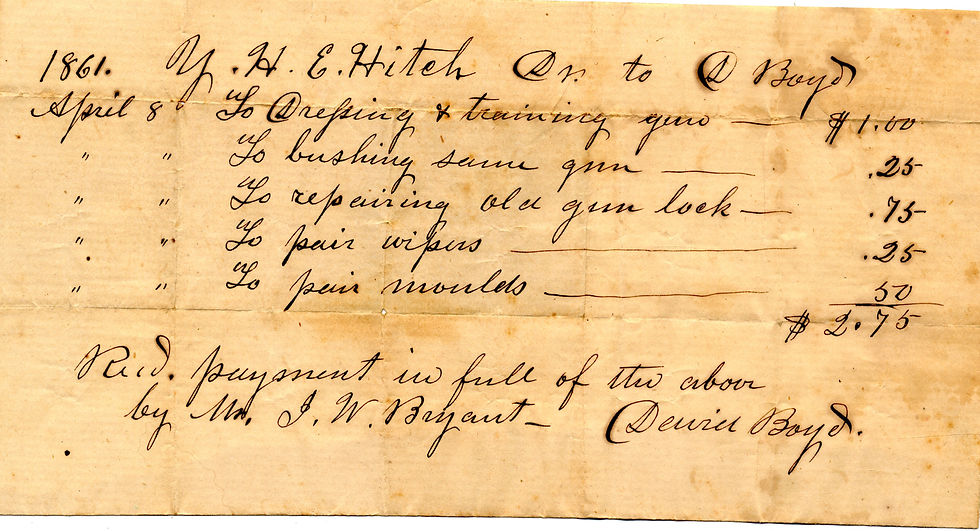
For Young Hitch and many of his friends and family, things had really escalated in the two years prior to his joining the reserves. South Carolina had become the first state to secede from the Union in December 1860 and not long after, the Civil War began with the firing on Ft. Sumter on April 12, 1861. By the end of 1861, all twelve Confederate States of America (CSA) had seceded, and there was flurry of activity to assemble military units – at first, at the state level and then at the national level for the CSA. One interesting item in the collection is a simple receipt (See the Figure) for services that this writer initially overlooked as just an unimportant piece in the collection. However, in examining the item in context, we see its underlying importance to the story. Dated April 8, 1861, it is just four days prior to the war’s beginning at Ft. Sumter and tells us that Mr. Hitch was getting his gun cleaned and ready for whatever action or need it might face in the coming months. The once dismissed as “unimportant” item is eerily prophetic in its nature.
Another example of the uniqueness of this collection comes in the form of a letter from William P. Edwards to Y.H.E and Mary Ann Hitch dated March 11, 1861. Edwards is Mary’s brother living in Marshall County, AL and, after some brief family pleasantries, it illustrates to us more of the uncertainty and upheaval at the time. Edwards writes in his own coarse style, “I want you to rite whither South Carolina has with severed from the union or not and what tha are doing ther. tha have caried thing big hear tho tha are sorter settling down like a warme of bees since Cing li wham has taken his seet. I don’t hear mutch noyes nowe all camm as a lamb tha was a grait noyes that he shod not take his seet tho I heard that he had taken hit. Thes big men cood not get thos little men to goe and keep him from his seet.”
By carefully dissecting his words, we see a time when secession was a prelude to the war. He was asking for news whether it had happened in South Carolina and is referencing “Cing li wham” Moore (sic, Sydenham Moore), Congressman for the 4th District of Alabama at the time. Moore had been representative for 4 years before withdrawing from his post in January 1861 when Alabama seceded. What Mr. Edwards did not apparently know when he penned the letter, was not only had South Carolina seceded but, by then, in order, Mississippi, Florida, Alabama, Georgia, Louisiana and Texas had also seceded. So, Mr. Sydenham Moore had NOT taken his “seet,” rather, he had withdrawn from the U.S. Congress after his state had seceded on January 11, 1861. South Carolina had been first to secede and the six others followed soon thereafter. They were quickly joined by, respectively, Virginia, Arkansas, North Carolina, Tennessee, Missouri and Kentucky[2] to complete the formation of the CSA.
Private Hitch’s participation in the 9th South Carolina Reserves ends in the 90 days that he had committed to and then he continued service by enrolling with Company I, 16th South Carolina Regiment on February 13, 1863. This time, instead of signing for “90 days,” he commits to service “for the War,” an indefinite period of time that caused his wife and sons much worry. Before beginning this service, he was granted leave to go home for six weeks not knowing that he would never again see his beloved family and farm in the foothills of South Carolina.
It was during this time of transition that Hitch pens two undated letters (but ones that we know are from mid-January 1863). In the first, Young tells his boys that his unit has drawn their guns, the Enfield rifle-musket. Young is excited and feels “…just like I could take a few pops at a Yankey with my gun. It is not near so heavy as I supposed it would be.” In the second, he writes, “Write soon & let me know if you got the salt & my likeness…” The army had just issued Hitch his rifle, a British Enfield 1853 Model rifle-musket that he judged quite well and, he had gone to a studio to get his photograph (his “likeness”) taken with his new gun so that his family would have a memento to remember him as he served over the coming months. The photograph of Young Hitch in the opening to this blog post is that “likeness” of Private Hitch and his rifle taken in January 1863.
The rest of the collection focuses on Hitch’s letters to and from his wife and young sons as he traverses throughout the south with the 16th South Carolina (see the Figure for a period map superimposed by yours truly of the journey of Pvt. Hitch during the war). The letters are rich with content of camp life, the talk of diseases that killed more soldiers than actual combat, the occasional happy events, the sights and sounds he experienced and the tragedies of the war.

We experience many examples of heartfelt love between Young and Mary Hitch. On June 8, 1863, he writes from Mississippi, “This leaves me tolerably well at the present I want you to write to me, the 30 of April was the last letter I got from you. Direct your letters to Jackson, Miss. So I wish you & children well Both for time & eternity. Mary, as this may be the last letter that you may ever get wrote by me to you, if it should be my lot to get killed or die, I want you not to grieve after me at all for I hope when I am no more here on Earth that I will be at rest in heaven. Mary I may be deceased but I hope you will still pursue your course as you have been doing. Let us try to be prepared to meet God in peace. So I bid you farewell.” In it, we see his forlornness of being away from home and the slowness of communication in the mid-19th century, especially during the Civil War. We also see in him that specter of mortality that many soldiers in camp were contemplating on a regular basis.
Besides the gravity of thought that Young Hitch had expressed into words, accompanying the letter was a drawing he made of Mary Hitch (See Figure of the doodling herein). A “battlefield doodling” as these renderings are typically called by historians, Hitch chose to do his of his most cherished memory – one of his beloved wife. At the time, the 16th South Carolina was in Jackson, MS heading towards Vicksburg to try and help the Rebel army repel the Union army who had besieged that city. The southern CSA army would be too late as Vicksburg was to surrender four weeks later.
Paper and pens and ink became very scarce during the war and the collection shows this where Hitch began writing home on used paper from field hospitals and the like. In several letters he writes between the columns of older listings of soldiers with various ailments confined to a field hospital so the reader can glean not only the happenings with regard to Hitch’s letter at the time but we can also indirectly see what was happening to his fellow soldiers.
On the march towards Vicksburg, Private Hitch contracts the measles on June 30, 1863 and is he himself confined to a field hospital, which was actually a private residence converted to the purposes of being a hospital. While there, at Mr. Odom’s house near Morton Station, MS convalescing, the Southern army was repelled back from Vicksburg towards Jackson thus leaving this hospital briefly behind the enemy lines. However, since the Union army was leaving the area quickly and the hospital was off the main travel roads by several miles, it was never discovered or Hitch and his fellow hospital mates may have become POWs. Measles was often a lethal disease during the Civil War and Hitch took some time to recover. On August 20, 1863, he writes to his son about six weeks after, when he was back in the hospital suffering from some of its lingering symptoms:

Dear son,
I take this opportunity of droping you a short letter to inform you where I am and how I am a getting along. I am in the hospital at the regiment. This is the third day I have been in this hospital. Dear Son, I have suffered a great deal since I saw you last. I suppose that you heard of me having the measles and me being left behind allmost right amongst the Yankeys. Lucian, Pa fared rough with the measles. I thought one week that I could not live. But for sum cause God has spared my life a little longer. Lucian, I calculated on being captured by the Enemy while I was sick. The Yankey passed in six miles of me on their way to Jackson & they returned by the same road. I was about halfway between Jackson and Vicksburg. The people where I staid treated me as good as I deserved probably but not as good as they could of done. I paid him $13.00 & would of give him as mutch more if they had acted more gentlemanly with me[3]. My health a little better today.
The war drags on from here and the 16th falls back from its intended support of Vicksburg and heads eastward through Mississippi to West Point, Alabama by August 26, 1863. From there it takes “the cars” (e.g., a train) north to Tennessee, then south to Rome, Georgia and back into Tennessee near Chattanooga before settling into Dalton, Georgia around Thanksgiving Day in 1863 where they would spend the winter. In some of the letters, Hitch shows his and his fellow soldiers’ lament in not having faced any direct combat action in any of the eight months since they left camp in South Carolina back in the previous March. They were late in getting to Vicksburg so saw no fighting and in the back-and-forth shuffling between Tennessee and Georgia from August to November 1863, they missed engagements at Chickamauga, GA in September and Missionary Ridge, TN in November.
In a September 18, 1863 letter from Private Hitch to wife Mary, he mentions he has seen an old friend from home, Simeon Thackston, who was part of Company G, 3rd South Carolina, That unit had already met with much action and he was wounded near Richmond in June 1862. Thackston relates to Hitch that their friend Oliver Moore, a 2nd Lieutenant, is also in Thackston’s unit but Hitch did not get a chance to speak to him. This was unfortunate because two days later in the Battle of Chickamauga, Moore would be killed in action. Hitch’s unit was encamped at the base of Lookout Mountain, TN from this time till they left for Dalton, GA on November 23. They were part of the siege of Chattanooga but saw no direct action. This is the time when Union General William T. Sherman arrived in Tennessee from Vicksburg and prepared to begin his infamous drive towards at Atlanta.
For Hitch and his fellow soldiers, the winter of 1864 passed rather uneventfully in Dalton. They had accommodations in small houses and so were in much better quarters than had when marching and pitching tents or sleeping outside. Things in the letters generally shift from the darkness of disease and relentless marching to everyday chores and activities. On February 2, 1864, Hitch writes to his wife, “Mary, I have just bought half a square of this sort of paper. I give two dollars for it. And I just bought me a new pair of socks. I paid a five dollar bill for them. And I have just six dollars fifty cents of money in hand at present. Mary, I dismissed my old shoes yesterday morning Feb. 1st. they have been faithful old friends to me and have carried me over many a rough mile of rocks. The shoes that I have on are not worth mutch but they did not cost me a thing. They were a pair of the donation shoes. Mary, today has been wash day with me. I washed two pieces, a shirt and pair of drawers. Got them clean & white too.”
This passage is both interesting in its simplicity and also in what it says about the times. Inflation of the Confederate currency was running high and a pair of socks cost $5.00, an amount that may have been a week’s earnings before the war. Shoes for the entire Rebel Army were very scarce at the time and Young Hitch is experiencing this first hand as he “dismisses” his former worn-out pair and dons a “new” pair of barely functional “donation shoes.” We also see that paper is still scarce and expensive but Hitch makes it a point to buy it anyway to keep open the lines of communication home. The image hereing shows an envelope from the collection that was found inside-out and reused to extend its life due to the shortage.

Other letters during this time tell us more of camp life in 1864. On February 8th, Hitch writes his son J.J. Hitch and tells him of the 16th South Carolina’s participation in a general army review for CSA General Joseph Johnston in Dalton. Upwards of 32,000 soldiers participated and columns stretched miles as Hitch writes, “It was so long that it took General Jo Johnson a good while to lope his pretty bay mare around.”
There was a large snowstorm on March 22nd that blanketed the whole east coast of the U.S. and left 5” in the Dalton, GA area. Hitch writes of it in a March 24, 1864 letter: “Mary you have often heard of snow balling. If you had been here yesterday & the evening before you could of seen the biggest one you ever did sure. Tuesday evening Jacksons Brigade made an attack on ours & I am sure I never saw snow fly before. And yesterday I never saw & heard the like it was not just a few men it was hundreds against hundreds. One Brigade would charge another & fight until the ones they had charged would get to hard for them when they would break for home & the others after as hard as their heels could carry them. And then sutch whooping you never heard. Each side would take prisoners all they could. I was on post a part of the time & then on my line and on each side they did not aim their missiles at me at all but I was in the hot place, one army on the one side & the other on the other. Their balls flew around me thick & heavy. I did not take any part with them for I was on guard & would not no how.” A moment of levity in a trying and desolate time in our nation’s history.
About this time, the Union army began to drift southward and tested the Southern Army’s strongholds around Dalton with an attack on February 24-25, 1863. It was not a major affair in Civil War terms and historians agree that they were just systematically testing General Johnston’s army for any weaknesses. The intelligence from those maneuvers would be used during the Atlanta Campaign that would begin later in the Spring of 1864. Again, Hitch’s unit saw no direct action as they were assigned to defend a road to the rear. However, in a February 28 letter to his wife, Young writes that he could hear the action and that “…they put their shots in like hail all day long…we lost 110 men killed dead, the loss on the enemys side I don’t know.” Official accounts of the battle state that the South had suffered 140 casualties so Hitch’s eyewitness knowledge of 110 killed matches closely. The North lost more than twice as many according to the same official accounts.
As the North pushed the Southern army further to the south and east towards Atlanta, things got hotter for Hitch’s 16th South Carolina and soon they were not pining for action any more. In his letters home, we see an increase in the frequency and duration of guard duty and military exercising with a great anticipation of action that might soon occur. By May 1864, the Atlanta Campaign got underway in earnest and Hitch feels the danger in the air when he pens on May 1st a longing for home: “Mary I often think of home & the past & gone by days of pleasure that I have spent with you. I hope that I may live to get home again & that we may Enjoy a few more days on Earth together. I want to see my old home again verry bad. I would be glad to see the old chicken coop or the sheep house. And I would love to see them pretty shade trees & the rose bushes in the month… To come home would be a treat to me sure at this time.”
During the next six weeks, Private Hitch and the rest of the Rebel Army are steadily pushed backwards to the very outskirts of Atlanta. There had been many skirmishes along the way and CSA General Johnston, facing overwhelming numbers of Union soldiers, uses a favorite tactic of his to fight just a bit and then fall back to a defensive position. Finally, by mid-June 1864, he decides to dig his Army in near Kennesaw Mountain, about 20 miles NW of Atlanta, in a line that began just north of Marietta, GA and formed a long semi-circle south and westward for several miles. This is where he plans to mount his major defense of Atlanta and Hitch and the 16th South Carolina, as part of Gist’s Brigade, are dug in behind strong earth and breast works at just about the midpoint of that line, ½ mile southwest of the Kennesaw Mountain summit. On June 2nd, Private Hitch writes his final letter to his wife where he prophetically composes:
“This may be the last you hear from me. God only knows. But if I fall I hope to fall doing my duty. If I should survive this war let this be my boast that I served as a private in the great struggle for Southern independence. -So I remain your husband, Y.H.E. Hitch”
The next document in the collection is a letter from Private William Berry Scruggs, Mary Hitch’s brother-in-law, dated June 20, 1864, who writes, “Line of Battle near Marietta, Cobb County, Georgia. June 20th 1864 Dear Sister, It is made my painful duty to inform you that your dear husband is no more is was shot in the head on yesterday while on skirmish duty, about 10 oclock. He, Hosea Holcomb, Absalom White and Andrew Forester were all behind a temporary breastwork. He had just discharged his gun and before he recovered his former position, he was struck by a small ball. He fell and, as he fell, he said “Oh Lordy.” Dear Sister, I have the melancholy pleasure to inform you that he made a good soldier. He lived respected and died lamented by all the co and regt who knew him.”
Private Young H.E. Hitch had died while on picket duty near Kennesaw Mountain on June 19, 1864 leaving a wife and sons John J. and Lucian Hitch, ages 16 and 9, respectively. His family was devastated so much so that every letter he had written from the time he entered service till the day he was killed was carefully preserved. The preservation continued over the years as the generations came and went and finally they were rediscovered by Ms. Mowbray in her house in Fountain Inn. A certain serendipity exists in this story for, when she found them, she sought this writer via a tip from a local person who knew I had done a lot of work on the Hitch family. Private Hitch was her 2x great grandfather and a collateral cousin of this writer and in those moments, and the two years that followed, it is almost as if Private Hitch was reaching beyond the grave to try and tell his story. Ms. Mowbray and I would oblige his wishes.
While this article has covered only a few items, the entire story can be experienced in a book we assembled back in 2015. The book, available in the Nabb Center library and via purchase, is called Oh Lordy!, A Story of One Family’s Trials During the Struggle for Southern Independence as Told Through the Letters of Private Young H.E. Hitch, Company I, 16th South Carolina Volunteer Infantry and includes a transcription of all the correspondence in the collection as well as a brief history of the Hitch family’s roots on the Eastern Shore of Maryland and a complete story of Company I as eye-witnessed by Private Hitch and within the context of the Civil War.
The collection is outstanding - there are hundreds of pages of items that promise to become a foundation for scholarly historical information and interpretation for many years to come. The Nabb Center is the perfect place to house it and is honored and proud to have it within their protective archives so that the Young Hitch legacy can be enjoyed for many future generations. Interested readers are invited to visit the Center and view this excellent collection for themselves.

[1] Letter in the Private Young Hitch Collection dated Aug 16 1862 from Capt. S.D Thackston to Mr. Y.H.E Hitch stating “You are hereby appointed Captain of the patrol in Beat Company No. 1…”
[2] Missouri and Kentucky never officially seceded because of their pro-Union governments but their citizenry declared them part of the CSA by the end of 1861.
[3] The letter of Aug 20 1863 between Young and his son Lucian helps put into perspective the disease many soldiers faced during the war. Disease killed many more soldiers than combat. The close quarters these soldiers kept helped diseases like measles, dysentery, cholera and others spread rapidly and lethally through the ranks. Also in the letter we see where Hitch pays “Mr. Odom” $13.00 to help offset the homeowner’s expenses, a common practice of the time.


I was wondering if you have any other info about the 16th SC? I have a 3x Great-grandfather who served in the 16th (Major Franklin Newport Blakeley). I have his old pension papers but can't find him listed in a single listing of soldiers or officers. If you have any info, I'd love to talk with you about it.